| Products/Services Used | Details | Operation |
|---|---|---|
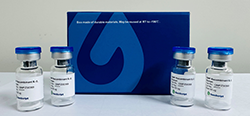
| Recombinant Proteins | Samples were transferred to PVDF, blocked with 5% milk and probed with C-Myc antibody (Genscript A00173-100), Rad53 antibody (Abcam ab104232), histone H4 antibody (Abcam ab10158), or actin antibody (Thermofisher Scientific MA1-744) | Get A Quote |
During eukaryotic DNA replication, DNA polymerase alpha/primase (Pol α) initiates synthesis on both the leading and lagging strands. It is unknown whether leading- and lagging-strand priming are mechanistically identical, and whether Pol α associates processively or distributively with the replisome. Here, we titrate cellular levels of Pol α in S. cerevisiae and analyze Okazaki fragments to study both replication initiation and ongoing lagging-strand synthesis in vivo. We observe that both Okazaki fragment initiation and the productive firing of replication origins are sensitive to Pol α abundance, but find that the absence of the replisome adaptor protein Ctf4 only impairs lagging-strand initiation. Our... More